Music Techniques for Beginners: Essential Skills to Get Started

Learning music can be an exciting journey for beginners. Developing a solid foundation in music techniques helps establish a clearer understanding of how music works. Focusing on fundamental concepts, such as rhythm, melody, and harmony, is essential for anyone starting in music.
Understanding the basics of music theory not only enhances creativity but also facilitates better communication with other musicians. Beginners will benefit from grasping key signatures, scales, and simple chord progressions as they explore their musical interests.
By practicing essential techniques, aspiring musicians can build confidence and skill over time. This article offers straightforward guidance and tips to help beginners navigate the world of music with clarity and purpose.
Understanding Music Theory
Music theory serves as the foundation for composing, performing, and analyzing music. Key concepts include scales, chords, and time signatures, which are essential for any beginner aiming to grasp the structure of music.
Scales and Keys
Scales are sequences of notes that provide the building blocks for melodies and harmonies. The major scale consists of whole and half steps arranged in a specific pattern: W-W-H-W-W-W-H. This scale creates a bright sound. In contrast, the minor scale evokes a more somber tone and features a different step pattern: W-H-W-W-H-W-W.
Key signatures indicate which notes are sharp or flat, establishing the tonal center of a piece. For example, C major has no sharps or flats, while A minor has the same key signature. The circle of fifths visually represents the relationships between keys, aiding in understanding how to transition between different scales and keys effortlessly.
Chords and Progressions
Chords are formed by stacking notes together, typically in intervals of thirds. The most common types include major chords, which have a happy sound, and minor chords, which sound more melancholic. A seventh chord adds depth, creating a richer harmonic texture.
Progressions link chords in a sequence, driving the music forward. Common progressions, such as the I-IV-V-I, establish a strong sense of resolution. Understanding how to construct and manipulate these chords allows for creativity in writing and improvisation.
Time Signatures and Rhythms
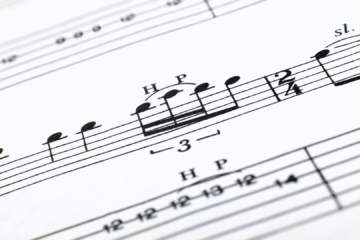
Time signatures dictate the rhythmic structure of a piece, indicating how many beats are in each measure and what note value gets the beat. The most prevalent time signature is 4/4, known as common time, which features four beats per measure. Other signatures, like 3/4 and 6/8, offer different feels and moods to a composition.
Rhythm is created through notes and rests, determining the duration of sounds and silences. Beginners should practice counting and clapping exercises to develop a solid sense of timing. Mastery of these principles leads to more confident performance and composition.
Practical Skills
Developing practical skills in music encompasses various elements crucial for beginners. Key areas include rhythmic training, melodic development, and mastering dynamics and expression. Each area contributes to a well-rounded musical foundation.
Rhythmic Training
Rhythmic training is essential for understanding the pulse and structure of music. Beginners can start by tapping their feet to a steady beat, gradually incorporating various rhythmic patterns.
Key Components:
- Beat: The basic unit of time in music.
- Tempo: The speed at which a piece is played, usually measured in beats per minute (BPM).
- Meter: The arrangement of beats into regular groups, such as 2/4 or 4/4.
Practicing with a metronome helps develop precision in timing. Syncopation adds complexity and interest to rhythms; it occurs when stresses are placed on weak beats. Incorporating various rhythmic exercises enhances creativity and builds confidence in performing.
Melodic Development
Melodic development involves creating and understanding musical notes and phrases. Beginners should focus on playing simple melodies on instruments like the piano.
Important Aspects:
- Notes: Individual sounds that form melodies.
- Whole Step and Half Step: The distances between notes that determine scale structure.
- Chord Progressions: Sequences of chords that form the harmony underneath melodies.
Practicing intervals—like major and minor second—fosters ear training and aids in recognizing melodies. Experimenting with different timbres adds variety. Creating short melodic lines encourages improvisation skills and enhances musical texture.
Dynamics and Expression
Dynamics control the volume and intensity of sound, significantly affecting a performance’s emotional quality. Beginners should learn to play with varying dynamics, from piano (soft) to forte (loud).
Key Factors:
- Articulation: Influences how notes are played, affecting clarity and style.
- Timbre: The unique quality of sound produced, varying between instruments and playing styles.
Incorporating dynamics into performances creates contrast and interest. Experimenting with expressive techniques, such as crescendos and decrescendos, adds depth to music. Beginners can practice by playing familiar pieces with different dynamic levels, facilitating emotional connection and artistic expression.
Technology in Music
Technology has transformed how music is created, produced, and consumed. Essential tools and techniques empower musicians to compose, record, and refine their work with unprecedented ease and flexibility.
Digital Audio Workstations
Digital Audio Workstations (DAWs) are central to modern music production. DAWs offer a range of features that facilitate recording, editing, and arranging musical compositions. Popular software options include Ableton Live, Logic Pro, and FL Studio.
These platforms support virtual instruments and effects, enabling musicians to experiment with sound design. Users can manipulate audio tracks, adjust panning, and apply EQ, reverb, and various sound effects.
A good DAW streamlines the workflow, permitting improvisation and quick adjustments. The choice of DAW impacts production style, making it crucial for beginners to explore various options before committing.
Mixing and Mastering Basics
Mixing and mastering are vital steps in music production. Mixing involves balancing audio tracks, adjusting volumes, and applying effects like compression and reverb.
Key tools include:
- Equalization (EQ): Adjusts frequencies to enhance or reduce specific elements.
- Panning: Controls the stereo positioning of sounds.
- Automation: Changes volume or effects over time for dynamic sound.
Mastering is the final process where the mixed track is prepared for distribution. This includes optimizing loudness, enhancing clarity, and ensuring consistency across tracks. A well-mastered track ensures it meets industry standards and sounds good on various playback systems.
Recording Techniques
Effective recording techniques create high-quality audio. Musicians often start by selecting the right microphones and audio interfaces. A good microphone captures the nuances of vocals and instruments, while an audio interface converts the analog signal into digital format.
Placement is crucial; for instance, positioning a microphone close to the sound source can capture more detail. Studio monitors play an essential role in monitoring recordings accurately, helping musicians evaluate their mixes.
Using drum machines and synthesizers can enhance recordings by adding unique textures. Experimenting with different recording techniques allows artists to refine their sound and achieve a polished final product.

0 Comments